


Your shopping cart is empty!
Cucumber "Dirigent" F1

Cucumber "Dirigent" F1
5
1
Cucumis sativus L.
3.03€
Ex Tax: 2.45€
Ex Tax: 2.45€
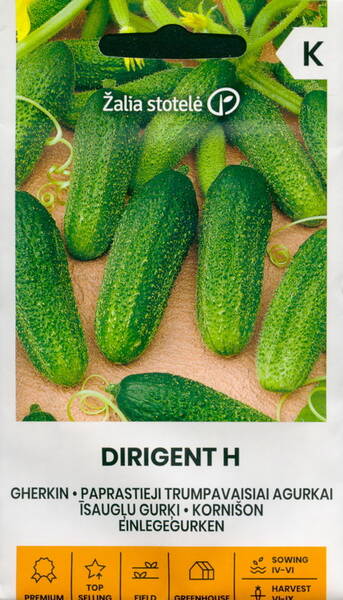
Cucumber “Dirigent” F1 (Conductor) — Cucumis sativus L. — an improved “Concerto”.
A self-pollinating (parthenocarpic) gherkin-type cucumber hybrid, highly resistant to cucumber mosaic virus and powdery mildew.
The fruits are entirely free of bitterness and are absolutely perfect for canning.
1 gram = 30—45 seeds.
A self-pollinating (parthenocarpic) gherkin-type cucumber hybrid, highly resistant to cucumber mosaic virus and powdery mildew.
The fruits are entirely free of bitterness and are absolutely perfect for canning.
1 gram = 30—45 seeds.
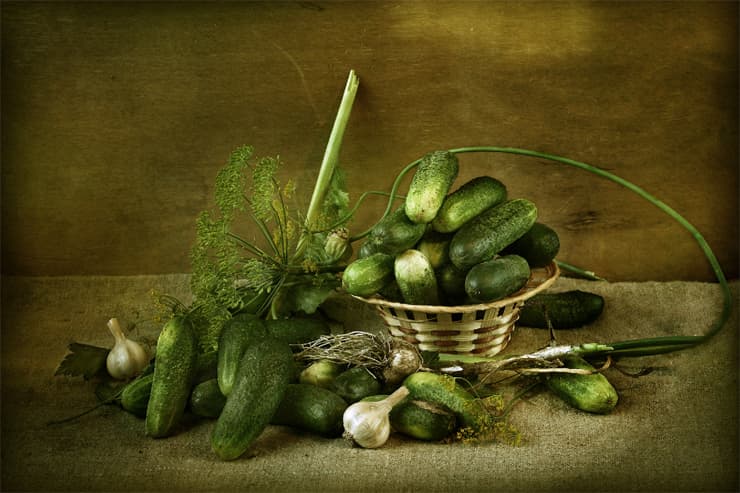
* Early cucumbers.
Cucumbers are particularly valuable early in the season, just when mass sowing in the beds is barely beginning.
How to get extra-early cucumbers?
One of the methods is sowing seeds in insulated (warm) beds. In mid-April (on soil dug up since autumn), prepare a bed. Where you plan to sow cucumbers, dig a deep trench 20 cm deep and 40 cm wide. Fill the trench with everything that hasn't rotted over the winter: debris, sawdust, dry grass, and even old rags (but strictly no plastic wrap or cellophane!). Pour 15 buckets of settled water into the trench filled with this biofuel. Compact the contents of the trench tightly, cover with soil, level it, and make furrows along the edges of the bed, watering them with a strong potassium permanganate solution.
Place dry cucumber seeds in the furrows at a distance of 10 cm from each other. Set up wire hoops along the edges of the bed, secure them at the top with a batten, and cover with plastic film.
Frosts are still common at this time, but with such planting and under such cover, seedlings appear in just 5—6 days. It is also advisable to water them with a potassium permanganate solution.
As the weather warms up, gradually open the film.
Care is simple: soil loosening, feeding with mullein (cow dung) solution. Mineral fertilizers are not used during the laying and “burning” stage of such a bed, so as not to burn the young roots.
Where cucumbers have sprouted too densely, thin them out by transplanting the seedlings to an adjacent bed. By mid-June, an experienced grower will harvest the first cucumbers, bringing joy to themselves and their family...
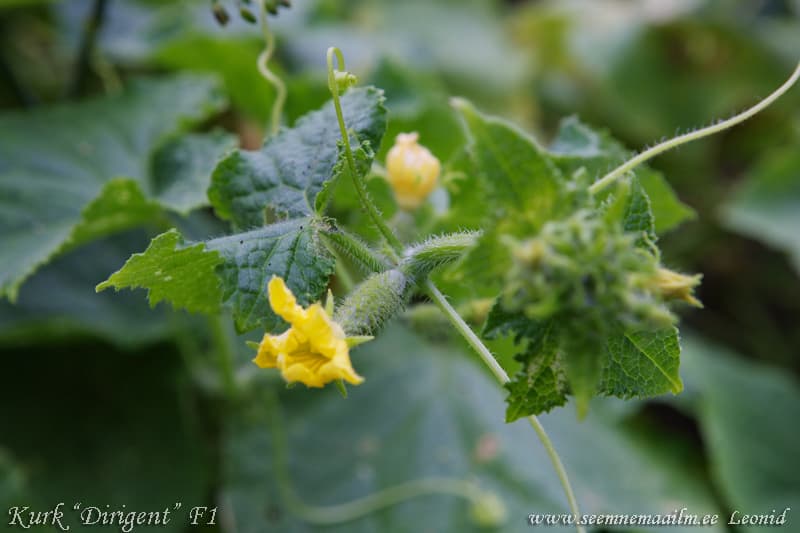
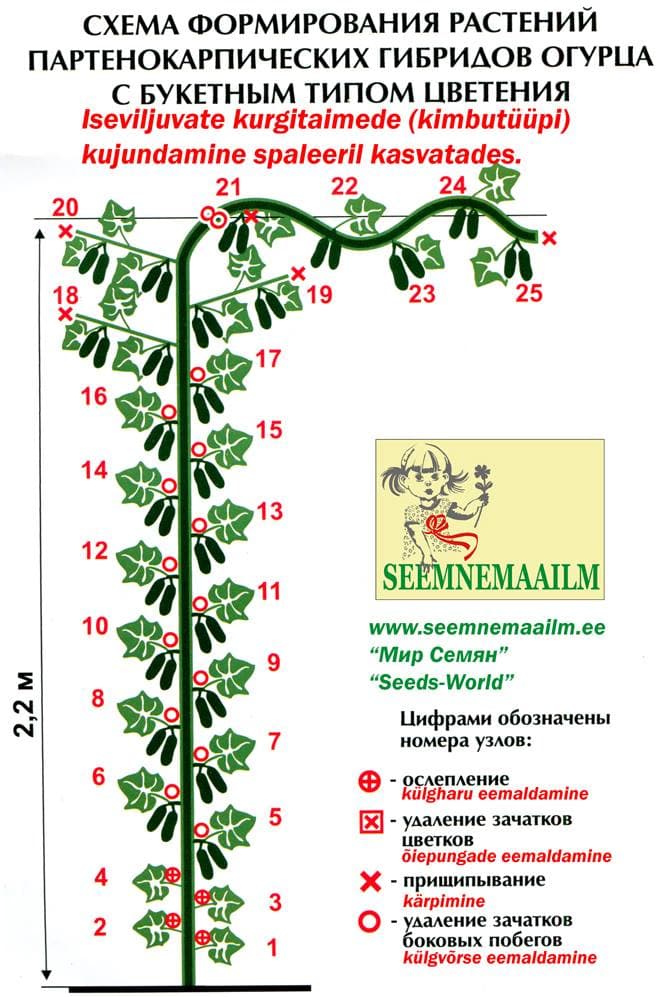
* Cucumber Nutrition Guide:
If the cucumbers are round but taper at the stem — lack of potassium. Use 1 cup of ash per bucket of water, 1 liter per plant.
If the vines are thin, leaves are small, and the cucumbers themselves are lighter than usual — lack of nitrogen. Water with a mullein solution, 1 liter of mullein per bucket of water, applying 1 liter per plant.
Excess nitrogen: Excessive application of nitrogen fertilizers, especially before the onset of mass fruiting, causes excessively strong vegetative growth and insignificant formation of female flowers. In production conditions, an excess of ammoniacal nitrogen is most often observed. Some of this nitrogen is released into the air as ammonia. This phenomenon occurs if manure is added to fresh high-moor peat instead of mineral fertilizers. Initially, nitrifying bacteria are practically absent in high-moor sphagnum peat, resulting in nitrogen accumulating in the substrate mainly in ammoniacal form. At this time, light brown spots appear on the edges of the leaves, which subsequently spread between the veins towards the middle of the leaf; sometimes they acquire an almost dirty white color. At the same time, signs of calcium deficiency may appear on the growing points and the youngest leaves as a result of the antagonism of these cations. These signs are usually enhanced by a lack of light.
Nitrogen deficiency: Signs of nitrogen deficiency are clearly visible by the spindle-shaped habit of the plants. Growth is severely stunted, vines are thin, hard, and quickly become woody. The leaves remain small, and most of them point upwards. Very few lateral shoots are formed. Ovaries fall off heavily, and some flowers die. First, premature yellowing of the leaf blade is observed on older leaves. It quickly spreads to younger leaves as well. If nitrogen starvation occurs later, yellowing can also affect middle-aged leaves. As nitrogen deficiency progresses, the fruits take on a pale yellow color.
Excess boron: The first sign of excessive boron intake is a lemon-yellow color at the edges of old leaves. Later, small light yellow, fairly evenly distributed spots appear along the edges of the leaves between the veins. These spots then become necrotic.
Excess iron: The direct effect of excess iron in the substrate is not observed, as it binds to other elements forming complex compounds. However, a visual lack of phosphorus, zinc, and manganese may appear.
Iron deficiency: Chlorosis appears on the youngest leaves. Only the main and lateral veins retain their green color.
Excess potassium: Visual signs appear along the edges of older leaves as a light yellow-brown stripe. It is usually associated with an increase in water-soluble salts, burning the roots.
Potassium deficiency: The edges of old leaves become lighter, spreading between the main veins towards the center. Leaves eventually become yellow-green with necrotic spots on the edges.
Excess calcium: Causes premature aging of leaves and reduces the uptake of iron, manganese, zinc, copper, and boron.
Calcium deficiency: Appears at the tips of shoots. Young leaves are small and initially dark green. Internodes are short, and the edges of young leaves become light, expanding into light stripes until tissue necrosis occurs. The leaves curl downwards like an umbrella.
Excess phosphorus: Forms complex and sparingly soluble compounds with calcium, iron, and zinc, causing a deficiency of these elements.
Phosphorus deficiency: Young leaves are dark green, while older ones turn a dirty grey-green. Later, large, unevenly distributed yellow-brown necrotic spots appear.
* For medicinal purposes, the fruits, juice, peel, seeds, and flowers of the cucumber are used.
The fruits contain potassium salts, nitrogenous and non-nitrogenous substances, fiber, vitamins of group B, A, and C, as well as iodine in an easily digestible form.
Cucumbers increase the secretory function of the stomach, contributing to a better secretion of gastric juice, stimulate the appetite, improve the absorption of fats and proteins, restore impaired metabolism, increase the output of urine and bile, and act as a mild laxative...
Since they consist of 95% water and have an extremely low calorie content, fresh cucumbers are highly recommended in dietary nutrition for obesity, as they perfectly satisfy hunger and promote weight loss.
However, one should refrain from eating salted and pickled cucumbers in case of gastrointestinal diseases, heart defects, atherosclerosis, hypertension, kidney diseases, and during pregnancy.
Folk medicine recommends drinking fresh cucumber juice as a calming and pain-relieving remedy for gastrointestinal diseases and constipation, and chopped fresh cucumbers or their juice are useful for edema associated with cardiovascular diseases.
A decoction of unripe cucumbers and vines is drunk for liver diseases.
! To avoid dyspeptic symptoms after eating fresh cucumbers, you should not drink cold or carbonated water and sugary carbonated drinks, and for some people — fresh milk.
Nursing mothers should be careful about consuming large amounts of fresh cucumbers, as many biologically active substances pass into breast milk and can cause mild stomach upset, rumbling, and spastic abdominal pain (colic) in infants. In such cases, it is useful to give infants dill water, and the mother can add fresh dill to salads, which neutralizes this side effect of cucumbers.
• Cucumber juice or juice mixed with natural honey in a 1:1 ratio.
Take 2-3 tablespoons 2-3 times a day for diseases of the upper respiratory tract and cough.
• 1 kg of ripe cucumbers (well chopped) infused for 8 days in 1 liter of quality vodka, then filter the infusion.
Wipe oily facial skin 1-2 times a day as an effective cleansing lotion.